Revenge Trading Psychology: Why Fewer Trades Win
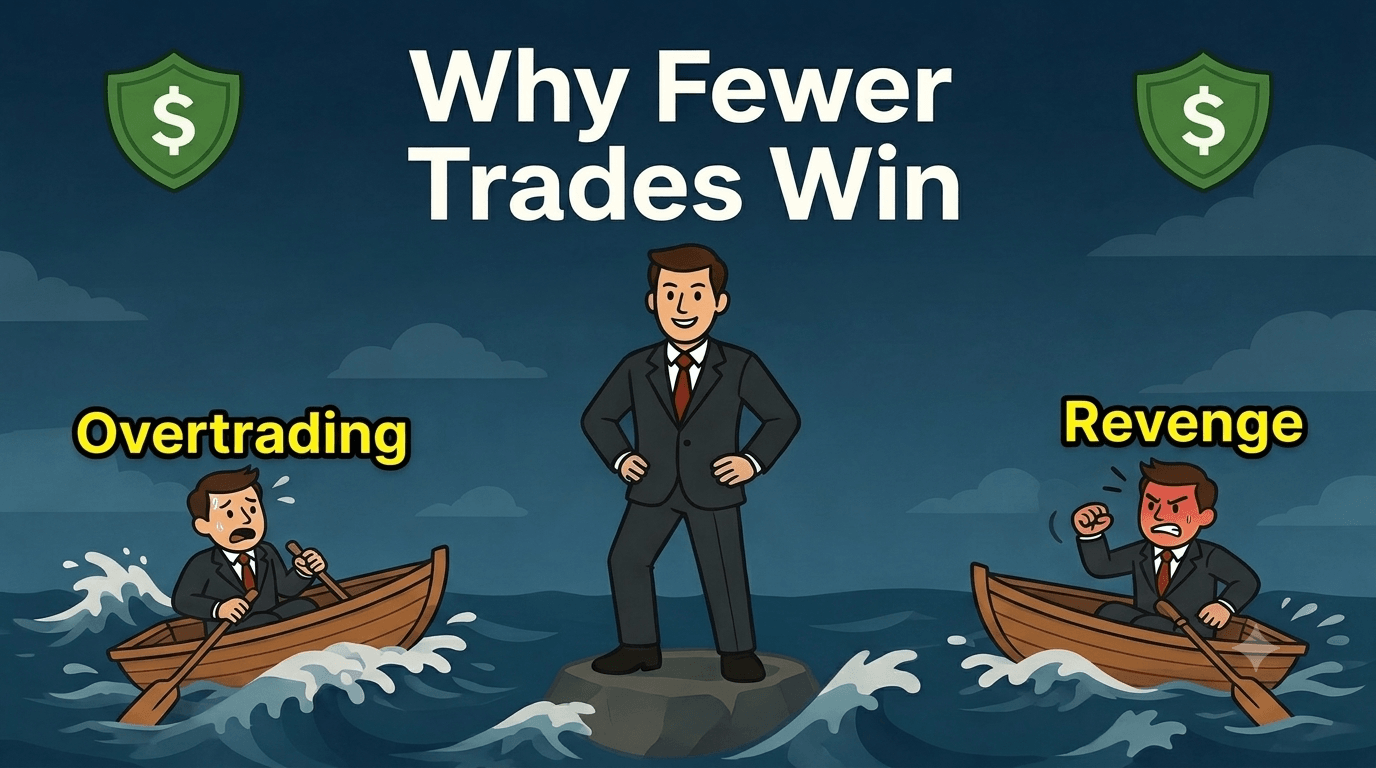
You lose a trade. Not a huge one — just enough to sting. And before the loss has even finished processing, your finger is back on the buy button. Not because you found a new setup. Because you want it back. Now.
That impulse has a name: revenge trading. It's one of the most common — and most expensive — habits in trading, and almost every trader has done it at least once. The uncomfortable truth is that revenge trading rarely comes from a bad strategy. It comes from a normal, human reaction to loss, applied to a market that doesn't care how you feel.
What revenge trading actually is
Revenge trading is any trade you take primarily to recover a loss or "get even," rather than because your setup and rules actually called for it. It usually shows up right after a losing trade, and it tends to escalate: the position gets bigger, the stop gets wider or ignored entirely, and the entry gets looser, because the goal quietly shifts from following your plan to making the number green again.
Traders sometimes call the state that follows a loss tilt — a term borrowed from poker. On tilt, you're still making decisions, but they're being made by the part of your brain that wants to undo what just happened, not the part that evaluates probability.
Why your brain pushes you toward it
This isn't a willpower problem. It's a wiring problem. A few things are working against you the moment a trade goes red:
- Loss aversion. Losses feel roughly twice as painful as equivalent gains feel good. Your brain isn't exaggerating for drama — that asymmetry is well documented in how people actually respond to risk.
- The illusion of a personal battle. It's easy to start relating to the market as an opponent — something you can "beat" if you just push harder. The market has no idea you exist. There is no rematch to win.
- Narrowed focus. Stress shrinks your attention down to the one thing that hurts. That's useful for escaping a threat. It's terrible for weighing probabilities across dozens of variables, which is what a good trade decision actually requires.
None of this makes revenge trading rational. It makes it predictable — which is actually good news, because predictable problems can be caught before they cost you money.
The overtrading trap
Revenge trading is really a subset of a bigger problem: overtrading. Once you're taking trades to feel better instead of to follow an edge, trade frequency creeps up — and that has a cost even when a trade doesn't lose.
Every extra trade adds spread, commission, and slippage. It adds another decision made under worse conditions than your best setups. And it adds emotional residue that carries into the next trade. A trader who takes four trades a day and only two are real setups isn't twice as active — they're diluting their edge by half.
The market will always offer you another trade. It will not always offer you a good one.
Why fewer trades often means a better trader
It's counterintuitive, but the traders who last tend to trade less, not more. Not because they're passive — because they're selective. Every trade they take has already passed a checklist before it happens: the setup is there, the risk is defined, and the reason for entering has nothing to do with the last trade's outcome.
| Reactive trader | Disciplined trader |
|---|---|
| Trades to feel in control again | Trades when the setup actually appears |
| Sizes up after a loss to "make it back faster" | Keeps size consistent regardless of the last outcome |
| Judges the day by how many trades were taken | Judges the day by how closely the plan was followed |
| Reviews trades rarely, if ever | Reviews every trade, win or lose, for what it says about the process |
Selectivity isn't a personality trait some traders are born with. It's a rule set — and rule sets can be built by anyone willing to follow them, including on the day it's hardest to want to.
Signs you're about to revenge trade
The moment right before a revenge trade usually has a recognizable shape. Watch for:
- Re-entering within seconds or minutes of a stop-out, with no new analysis
- Increasing position size specifically because the last one lost
- Skipping your normal entry checklist "just this once"
- A shift in internal language from "does this meet my setup" to "I need this to work"
- Trading outside your usual hours or instruments because you're still at the screen, still upset
If two or more of these are true right now, that's not a signal to trade faster. It's a signal to stop.
How to actually break the cycle
Knowing the psychology helps, but what stops revenge trading in practice is friction — rules that don't rely on willpower in the moment, because willpower is exactly what's compromised in the moment.
- Set a hard daily loss limit before the session starts, and treat hitting it as a mandatory stop, not a suggestion.
- Cap your trades per day in advance. When the cap is hit, you're done — win, lose, or scratch.
- Build in a cooldown after any loss — even five minutes away from the screen is enough to let the emotional spike pass before the next decision.
- Write down the reason for every entry before you place it, not after. If you can't state a reason that isn't "I need to win this back," don't take it.
- Review your losing trades the same day, while the context is fresh — not to relive them, but to separate "bad process" losses from "correct process, bad outcome" losses. They require completely different reactions.
Turning selectivity into your edge
The traders who eventually stop revenge trading don't do it by getting emotionally stronger. They do it by making their rules more visible than their impulses — and the single best way to do that is keeping a real record of every trade and the reasoning behind it.
A trading journal doesn't stop the urge to revenge trade in the moment. What it does is make the pattern impossible to ignore afterward: the cluster of oversized, rule-breaking trades that always follow a loss becomes obvious the moment it's written down and reviewed, instead of staying a vague feeling you half-remember. That's usually the turning point — not a new indicator, not more screen time, but finally being able to see the pattern clearly enough to interrupt it.
Fewer trades. Better reasons. That's not a smaller version of trading successfully — for most traders, it's the actual definition of it.